
















 You may have heard about Greta Thunberg at school, admired her for her strong character and determination or even dressed up as her for Halloween when you were little, with her biographies and books scattered all around your room. You may have heard her voice echoing through newspapers and podcasts, every issue she approached as practical and serious as the next. Greta Thunberg is known worldwide for her resilience and her spirit fighting against climate change. She started the “School Strike for Climate” movement of 2018, inspiring millions of students worldwide to take charge of their futures. As more and more globally joined the strikes, her protest quickly grew into an international movement with the hashtag #FridaysforFuture.
Although it’s very prominent in her discussions, Greta’s activism has never just been about the environment. In recent years, she has begun speaking out about other global issues connected to justice and human rights. She is known for angrily and directly confronting various politicians, never being afraid to acknowledge the consequences of our actions or speak out for the protection of our future children. Her latest discussion is one regarding the humanitarian crises in Gaza, where she believes innocent civilians are unjustly suffering for their simple existence.
Her recent joining of the humanitarian mission to Gaza had the goal of drawing attention to the suffering that’s happening and to challenge what she sees as unfair treatment. Along with 170 other activists, Greta boarded a boat to Gaza with nothing other than aid and support for the hurting palestinian civilians. The boat was part of the historic movement Freedom Flotilla, “a coalition of pro-Palestinian activists and campaigns that organizes maritime missions to challenge the Israeli naval blockade of the Gaza Strip and deliver essential humanitarian aid directly to its population”.
As Thunberg and the activists made their way through the international waters to reach Gaza, they were stopped by Israeli military forces, describing the incident as a ‘kidnapping’. Israel denies this, saying the action was a completely legal and necessary security procedure. The group said Israel’s response was “not an act of defence”, but rather “a brazen act of desperation”, stating that not only was it illegal and against war laws, but that they were not carrying anything that could present them as dangerous or threatening. Turkish journalist and flotilla participant Ersin Celik went as far as depicting the situation as violent, telling local media that he saw Greta Thunberg being “dragged on the ground” and “forced to kiss the Israeli flag.” These claims have not been independently verified, and the Israeli military has denied any mistreatment.
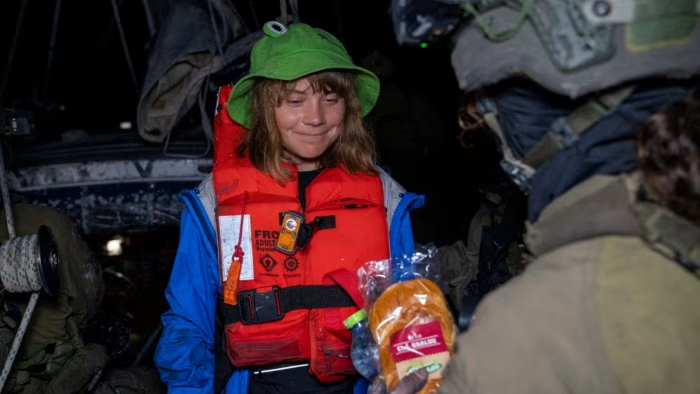 In order to support the fact that their intervention was peaceful, Israel’s Foreign Ministry posted footage from the interception, showing Thunberg sitting on the deck of a boat being handed water and a jacket by a member of the Israeli military. They then let out a statement that detained activists were being taken to the port of Ashdod and said “Greta and her friends are safe and healthy”. In terms of their feeling towards the initiative, the Israeli government was of the idea that it was only carried out for clout, calling the Flotilla a party boat or a “selfie yacht”. Greta’s response to this was: “I don’t think anyone would risk their life for a publicity stunt.”
After Italian civilians made their voices clear and organised a strike for the flotilla scandal, Italy’s Prime Minister Giorgia Meloni spoke out about the organized attempt to reach Gaza. She thought it a “dangerous and irresponsible” act, and responded to the strike by saying: “I continue to believe that all this brings no benefit to the Palestinian people”. She supported her perspective by further pointing out that there are better ways to bring aid over to Gaza that are currently being funded by the Italian government, and that going through the trouble of sailing by boat was bound to be futile. She also criticised the Italians’ behaviour of organising a strike and putting a stop to all public services in response to the flotilla capture by stating that the only impacts it had were the negative ones on the Italian civilians.
Seeing Greta speaking up about politics and taking action, young minds are not only encouraged to raise questions about international law and basic human rights but they are also pushed to formulate their own opinions about these serious matters and not simply leave it to the ‘grown ups’.
Are the innocent civilians in Gaza and Israel being killed and tortured for the consequences of their own actions? Or is it simply because of where they were born? Do they have anything purely sinful they have to pay for? Is it sinful enough to trade away their lives in order to compensate? Or is it in fact a leap of luck that we all hold a roof above our heads, eat a warm meal three times a day, and sleep in a comfortable bed every night?
