















Some useful definitions:
Axiom – a statement or proposition which is regarded as being established, accepted, or self-evidently true.
Ontology – the branch of metaphysics which deals with questions of the nature of being.
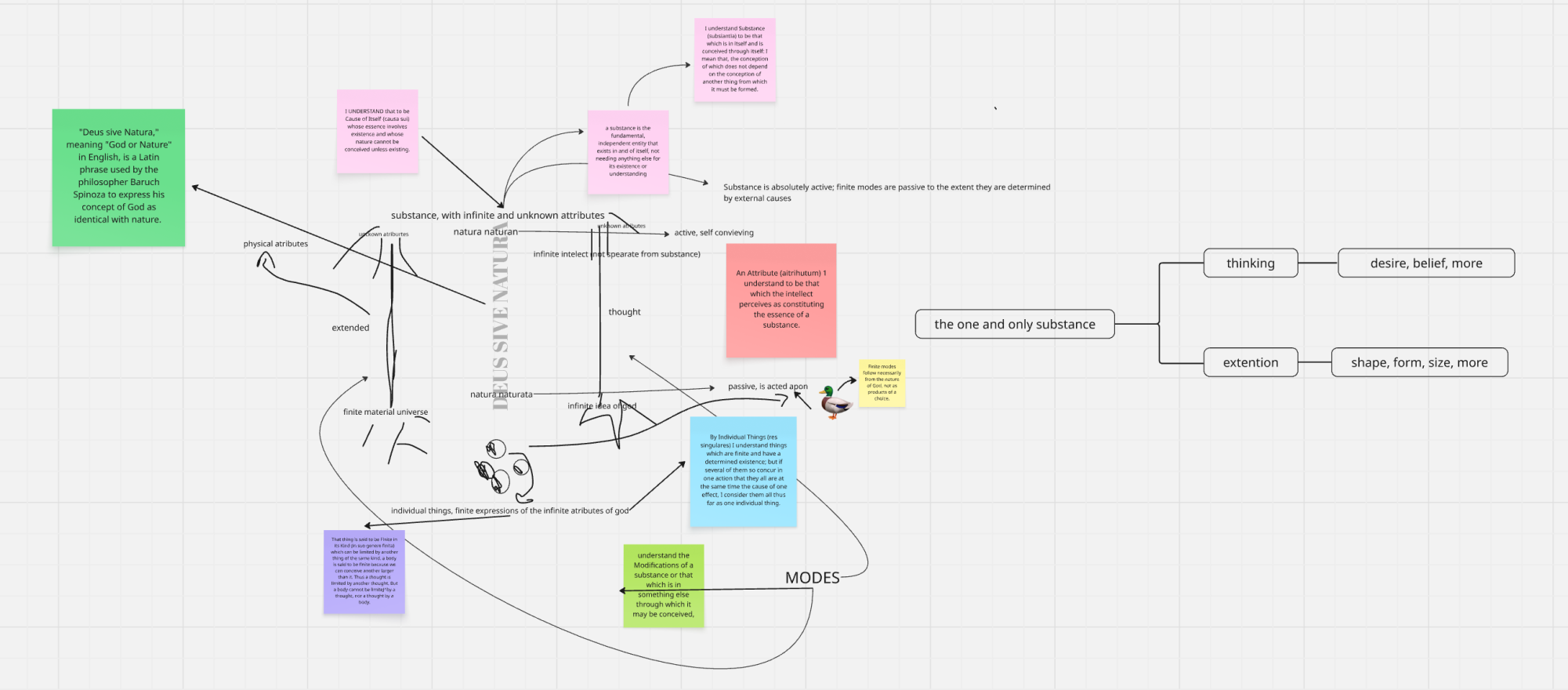
From Axiom I until about Axiom V, they are quite simple, and my explanations may thus seem overdrawn; however, it’s necessary to fully understand them to later be able to understand the propositions. I do not claim to fully understand them, and, full disclosure, these could be wildly inaccurate, however I think after about 1 year on Spinoza, I have at least partly grasped the first axioms in Ethics. Please read the definitions he gives at the start of ethics fully and attentively before you read ethics – I don’t think you will need them for this piece, as I have tried to simplify, but they are always useful, and any that I use will be present in the diagram I created. I will also briefly touch on the topology of expression at the end, and always have it more eloquently and adequately written for those who take great interest in this.
Axiom I: All things which are, are in themselves or in other things
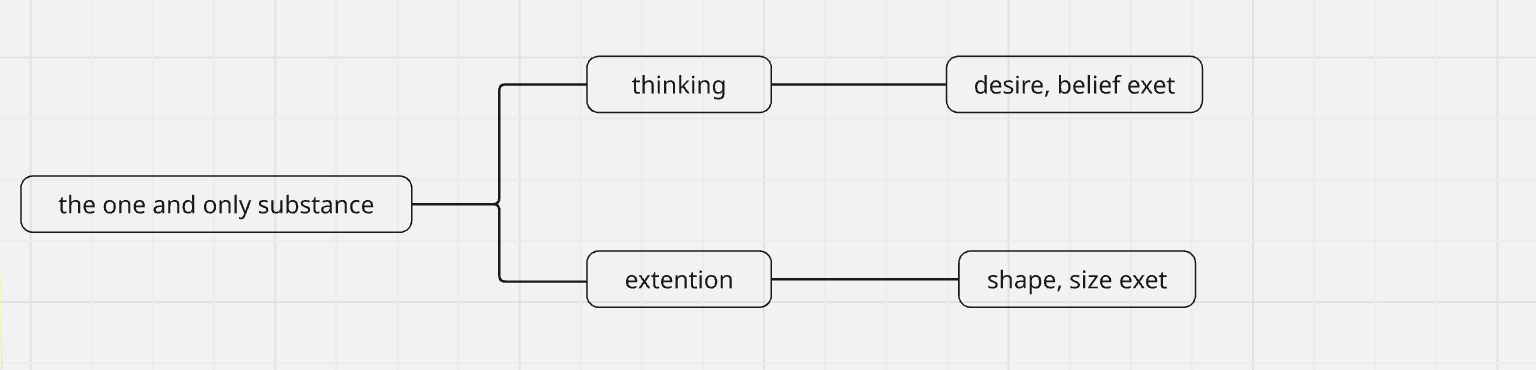 Spinoza’s first axiom institutes the primordial ontological bifurcation on which the entirety of Ethics is constructed upon. In that, to say all entities are in themselves or in another thing, is to divide substance and mode (see diagram). Substance being self-substituting as its essence carries into intelligibility, its existence, and its grounds for determination within itself. A mode possesses no such interior self-sufficiency; it’s only by virtue of inheriting in, and being conceived through its substance, which sustains it. Thus, this axiom applies to all equivocal ontological intermediaries — no entities can hover between independence (substance) or dependence (mode). Reality, then, exists in two tiers: the self-sustaining and the derivative. You might think of 2 cake layers, where one is formed of the extension from the base and is not itself separate from it. Spinoza will later argue that the category of substance is in fact uniquely instantiated, but the axiom is neutral, and its purpose is structural. It establishes a metaphysical dictation on how existence must be parsed as conceptual dependence mirrors ontological dependence. In this way, the axiom scaffolds the later demonstration of God (Nature).
Axiom II: That which cannot be conceived through another thing must be conceived through itself.
This axiom reaffirms the previous. The strict correspondence between ontological independence and conceptual autonomy, in that whatever cannot be conceived through another must be conceived through itself (note that here we are not talking about asexual reproduction). That is, the form of explanation must mirror the form of being. A substance whose essence does not presuppose external ground must be understood without recourse to its explicit determinants. A mode (lacking such self-sufficiency) can only be intellectually grasped within the conception of its substance that sustains it. A self-explanatory idea terminates the chain of dependence and inaugurates genuine knowledge. This undermines Cartesian dualism by claiming that mind and body, insofar as they are modes, cannot serve as ultimate explanatory termini. The axiom can be understood as methodological injunction; the clarity and adequacy of ideas depend on observation of the proportionality between what is a thing and the manner through which it should be conceived. In such, God should be conceived through themselves alone, whereas finite entities demand relational comprehension.
Axiom III: From a given determined cause, an effect follows of necessity, and on the other hand, if no determined cause is granted, it is impossible that an effect should follow.
Axiom III articulates Spinoza’s doctrine of absolute causal necessitarianism (you may have heard that Spinoza negates free will as necessity). From a determined cause, an effect follows not arbitrarily but ex necessitate—of logical and ontological necessity. It follows that without cause, no effect can be even conceived as possible. Imagine a ball, static on a table. In the absence of an external force (i.e., gravity or a “spectral hand”), the ball could never roll off the table. Spinoza, through this axiom, eliminates indeterminacy and dissolves the metaphysical space in which traditional views of free will act, including chance and brute spontaneity. This asserts empirical regularity, but deep structural identity between the order of causes and subsequently the order of effects. All events, then, are born from necessity with the ultimate ground lying within the workings of God or Nature (deus sive natura). Notably, the Spinozian God remains bound by the necessity that emerges from his own origin. As this axiom does not only apply to finite things, Spinoza denies that God possesses a freedom of indifference, a power of choosing between alternatives, or any form of volitional arbitrariness: acting otherwise would be to imagine a rupture between God’s essence and God’s action. God is only free if considered that, as a substance, he is the cause of his own necessity. Epistemologically, this axiom gives rational inquiry its warrant: knowledge of causes yields certainty because the relation between cause and effect is internally determined rather than externally imposed (N.B.: I am very underqualified in any kind of epistemology, probably the same as a waterbottle may be).
Axiom IV: The knowledge of effect depends on the knowledge of cause, and involves the same.
If you had not noticed, Spinoza conforms to rationalist epistemology, according to which our willing action and the action occurring are not two separate events; they are the same expression of the mind’s determined state. What we would call ‘volition’ is simply the mind’s awareness of a necessary causal sequence unfolding, not an independent force from the force which it produces. In such, it is not the will that initiates causation, but it is a modal expression of an antecedent chain extending infinitely beyond the mind’s awareness. In such the apparent autonomy from decision arises from the instinctive and involuntary ignorance of the determinant forces, not spontaneity or self-organisation. The unity of volition and action follows something quite obvious to the reader, but I feel compelled to state. For Spinoza, mental acts are embedded in the same metaphysics as physical events, abolishing any remaining dualistic conception of the Self. However, it is a shared sentiment that of a “free” mind; the feeling of absolute self-determination and individual, subjective experience informing decisions with no influence from a determined reality (be it through God, Nature, or otherwise). Spinoza would reply that this is only because the mind cannot survey the totality of forces that necessitate its acts. A crude example of this can be observed through ‘choosing’ the action of self-destruction. For Spinoza, no one ever seeks self-annihilation from sheer freedom; such an act must arise from external forces that overpower the individual’s conatus—the innate striving to persevere in being, while one might perceive their act to die as fully volitional, for Spinoza, this is an illusion; merely a mental register of an externally imposed necessity. Necessity thus becomes the universal grammar of being, applying with equal rigour to thought, motion, and the very structure of desire. (Sorry for the tangent).
Axiom V: Things which have nothing in common reciprocally cannot be comprehended reciprocally through each other, or the conception of the one does not involve the conception of the other.
Here, Spinoza enunciates the principle of non-intertranslatability between entities that share no common element or attribute. In other words, nothing can be compared to or understood through something that has nothing in common with it. If 2 things have nothing in common, their conceptions cannot mutually illuminate each other; they cannot stand as the epistemic ground for comprehending each other. This axiom is very important for the attack on dualism: it follows that if extension and thought share no attributes and neither can causally determine or conceptually explicit the other, mind cannot move body nor body move mind. Instead, each follows from the essence of one infinite substance. The axiom thus guarantees the autonomy of parallel orders —extended and thought— while preserving their unity under God. Generally, Axiom V forbids explanatory categorical mistakes; being something obvious, one must not attempt to deduce the properties of an item with something that shares no ontological register with it. In such, it enforces guards against anthropomorphic projections that Spinoza sees in superstition and teleology, making it both an ontological separator and an epistemological safeguard.
Axiom VI: A true idea should agree with its ideal (ideaium), i,e., what it conceives.
This axiom establishes Spinoza’s theory of adequation. A declaration that a true idea must agree with its ideatum (its object), not by means of superficial resemblance but by means of structural correspondence. It follows that truth is not an additional criterion that is applied to ideas, but an intrinsic property that arises from the idea’s internal clarity and causal adequacy. An idea is true insofar as it expresses the necessary order of a cause being, that a false or inadequate idea is one whose causal genesis is only partially grasped, in such leaving the mind passive. In this way, Axiom VI repudiates sceptical worries about the capacity of the mind to align itself with reality. This is due to the mind, along with the world, coming from the same divine substance, making their correspondence ontologically guaranteed. The truth is self-evident. A true idea reveals its own adequacy by the lucidity with which it is apprehended. In such, the possibility of scientific knowledge, ethical self-understanding, and intellectual freedom is grounded by this axiom as they are all dependent on the mind’s capacity to mirror the necessity inherent in nature.
Axiom VII: The essence of that which can be conceived as not existing does not involve existence.
Axiom VII delineates the relationship between essence, the intrinsic, a priori nature of something, and existence, the a posteriori occurrence of that something in the world, with much precision. I will go on to explain what is a very obvious (but very important) point. If a thing can be conceived as not existing—if non-existence does not contradict its essence—then its essence does not entail existence. This applies to all finite things, whose essences specify what they are intrinsically but not that they are observably. Their existence is contingent on external causes that actualize them. This axiom subverts traditional metaphysical arguments, those which illicitly deduce existence from conceptual content. This principle is the basis for Spinoza’s central theological claim, in that there is only one substance, God (Nature), whose essence does involve existence because to conceive it as non-existent would negate the very concept of absolutely infinite reality. Thus, the axiom isolates finite essences from the existential self-sufficiency and preserves the unique ontological privilege of the infinite substance, anchoring Spinoza’s proof of God’s necessary, eternal existence, and underscores the derivative, dependent status of all modal being.
Mini topology of expression link in Spinoza’s axioms (credits: Deluxe, Guattari)
In the architecture of Spinozist metaphysics, the axioms collectively constitute a singular, multidimensional topology of expression, wherein the ontology of substance and its modes is coextensive with the epistemology of thought. Axiom I institutes the foundational bifurcation: substance in its plenitude expresses itself infinitely, while modes, in their finitude, derive expression therefrom; instatiating the vertical continuum of inheritance, the primary scaffolding of being. Axiom II formalizes the epistemic analog: the conception of an entity is either through itself or through another, therefore enacting the epistemic corollary. A reflection of the plane of immanence later articulated by Deleuze and Guattari (from now referred to as D and G) proposes that this manifests a cognitive isomorphism into ontological stratification, rendering substance self-revelatory and modes derivatively expressive. Axiom III enforces the unyielding geometry of necessity: expression is neither contingent nor arbitrary, but unfolds with the inexorable rigor of a mathematical corollary. Each mode, then, even constitutive of divinity, traverses its causal vector ineluctably, thereby conferring continuity, rigidity, and the structural coherence to the expressive manifold. Axiom IV institutes unidirectional determinacy: effects are intelligible solely through their causes, producing a cascading arborization from universal to particular, the vertical flow of expressive actualization. Axiom V delineates lateral differentiation: attributes, thought and extension constitute non-intertranslatable domains, which are parallel yet coextensive, enacting a horizontal topology of expression and affirming the multiplicity of expressive planes. Axiom VI ensures ontic-epistemic resonance: adequation synchronises idea with object, engendering an isomorphic mapping in which cognition mirrors Nature’s expressive structure. Axiom VII distinguishes potentiality from actuality: finite essences, devoid of self-contained existence, require extrinsic actualization, situation substance alone at the apical locus of self- actualizing expression.
Taken in ensemble, the axioms instantiate a comprehensive, stratified geometry of expression: vertical (substance to modes), horizontal (attributes), dynamic (necessity and conatus), and epistemic (adequation) wherein every graduation of being, from divine immanence to the most passive finite mode, occupies a determinate locus within the topology of expressive power. Expression, in its entirety, unfolds as a continuous, structured, and intelligible process, wherein the ontology of nature and the epistemology of thought are coextensively and inextricably conjoined, prefiguring D and Gs vision of immanent, relational, and machinic topologies of being.
IMPORTANT – Spinoza does not use planes, levels, or stacked ontologies. This implies a vertical ascent, which aligns more with Neoplatonism or with a misread “ladder of knowledge” rather than Spinoza’s system, which is flat.
Read more
- Ethics – B D Spinoza
- Expressionism in Philosophy – Deluxe – not very related
- A thousand plateaus – THE SECOND MOST IMPORTANT AFTER ETHICS
- Anti-Oedipus – D+G – not very related
