
















Huntington’s disease is a progressive, neurodegenerative disease. Let’s break these terms down:
 We refer to Huntington’s disease as neurodegenerative because it causes the nerve cells in your brain to slowly break down and die. This can majorly influence your movement, cognitive skills, and more. This condition is caused by a mutation in the HTT gene, which produces an abnormal protein (called huntingtin) that kills neurons in the brain
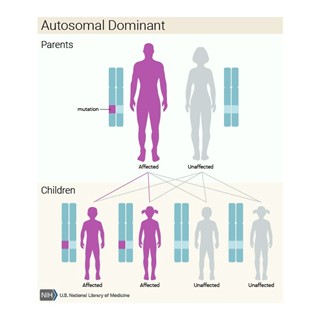 Huntington’s is also genetically inherited, meaning that the mutated gene can be passed down from parent to child. If you carry the mutated gene with you (be it diagnosed or otherwise), there is a 50% chance that your kids will inherit the same gene. The disease will usually ‘kick in’ in your later years, with symptoms usually appearing between the ages of 30 and 50. Although it does not instantly kill you, the disease is unfortunately fatal, with patients typically living 15-20 years after symptom diagnosis (this is the reason why this disease is, in fact, called progressive, as symptoms worsen over time). Although Huntington’s disease has no specific cure that can fully stop the illness, there are currently new treatments being developed that could potentially slow down its progression.
Some of the early symptoms of Huntington’s include clumsiness, involuntary jerking, and difficulty concentrating, but what does it actually do to a person?
We can divide the effects of Huntington’s into three categories: movement, thinking and behaviour/emotions. As mentioned above, Huntington’s causes nerve cells in your brain to die. This disease damages the basal ganglia, the sector in the brain primarily responsible for motor control. This results in an involuntary, dance-like movement called chorea. This can happen in different parts of the body, such as the face, limbs, and torso. As the disease progresses, movement, speaking, and even swallowing can become difficult in a person’s daily life. Huntington’s also affects the brain’s cognitive function, leading to memory problems, increased disorientation, confusion, and a significant loss of judgement. Lastly, it can lead to a host of mental health problems such as anxiety, irritability, depression, and in some extreme cases, paranoia or psychosis.
All of this impacts only one individual. What is the global impact of the disease?
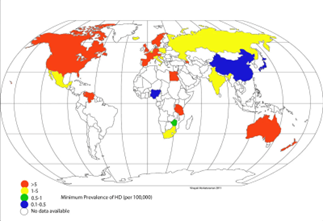 When collecting data, there are two different ways to identify how many people are affected by Huntington’s globally. The first is by focusing on how many individuals are currently suffering from the disease, a number known as the prevalence. The estimated prevalence of HD in 2024 would be that around 4.88 per 100,000 individuals are currently suffering from Huntington’s.
As demonstrated by worldwide medical records, the prevalence of HD varies with ethnicity and geographical location: since Huntington’s originates from northern Europe, it is not surprising that populations of northern European descent are those who are recorded as having the highest prevalence of the disease on a global scale, and that Europeans in general are the most prone to the gene.
The second method used in collecting statistical data on Huntington’s disease is the measurement of how frequently people are being diagnosed with it: in other words, the incidence of the disease. This number fluctuates more than the prevalence number, because Huntington’s is a genetic disease with a specific inheritance risk: the children of each person with Huntington’s disease have a 50% chance of inheriting it. So the incidence of HD depends on the number of children one has, and on how many of those children actually end up inheriting the gene. Because of this, the incidence of the illness changes every day and has been seen to increase over time.
But the real question is: Is there any way to stop this from happening?
Up until a short time ago, the answer to this question was no. Like many other chronic illnesses that impact the brain, finding a cure that can stop or even slow down HD was deemed near impossible, though research and medical trials never stopped trying to bring justice to individuals suffering from the condition and their families. Thanks to years of restless work, on the 24th of September of this year, a team of medical professionals managed to successfully treat HD for the first time, and throughout these past few weeks, symptoms in certain individuals have been reduced up to 75% thanks to the new cure. This means that, after treatment, the decline you would normally expect in one year would take place in four, giving patients decades of “good quality life”, something no one imagined possible for those diagnosed with HD.
The new treatment is a type of gene therapy given during a 12 to 18-hour-long, delicate brain surgery, in which the messenger part of the DNA is disconnected, blocking production of huntingtin. Sadly, the damage that has already been done to other neurons cannot be reversed, and consequently, the disease cannot be fully cured, but scientists will keep working night and day to ensure that more progress is made for patients suffering from HD.
In the meantime, the great success of the new treatment has brought joy and relief to many families scarred by Huntington’s disease around the world, and has given hope to millions of young people who won’t have to see this disease take their quality of life away for many years to come.