













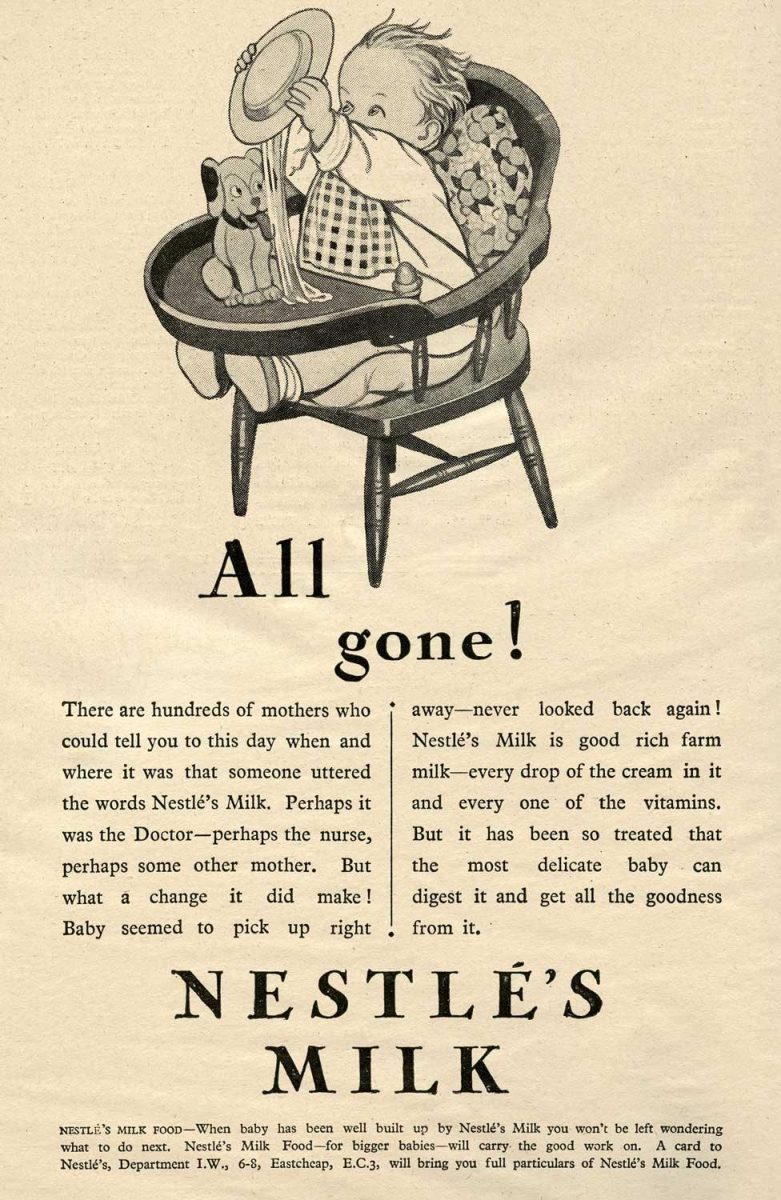
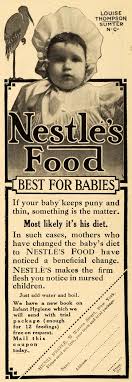
 Baby formula scandal (1970s – now) – After Nestle aggressively promoted their baby formula in poor countries, mothers stopped lactating, believing that the formula was better for the baby. An insufficient income led to them having to splice the over priced formula with water, causing widespread infant starvation and malnutrition. Nestle also used fake nurses (sales representatives in white uniforms) and paid off doctors to hand out the formula to give to mothers. They offered free architecture for hospitals to ensure the maternity ward was far from the children’s ward in order to make breastfeeding harder. As if this wasn’t enough, they deliberately printed labels for instructions in English and sold them in impoverished nations where English was not widely spoken, encouraging harmful practices.
Water exploitation and privatization (still happening) – Nestle has been accused of draining groundwater in drought-stricken areas (e.g., California, Pakistan) for bottled water, often for free or low cost. They have been said to be targeting water near indigenous communities. In some smaller communities children are getting sick because of the absence of clean water; seeing as Nestle sold their underground water, nothing comes out of taps and when it does, it is undrinkable. For clarification, they supposedly direct water away from the communities in order to both take it and use it as a dumping ground for their waste.
Child labor and slavery – Nestle has faced lawsuits and reports regarding the use of forced child labor in its cocoa supply chains, particularly in Ivory Coast. They have also tried to conceal their involvement in forced labor within prison camps!
Sugar in baby food – investigations show that Nestle puts an insane amount of sugar in their baby cereals and food for poorer countries, but they sell healthy alternatives in western, ‘richer’ ones. This contributes both to obesity and health issues.
Miscellaneous
→ Price Fixing: Involved in scandals regarding price-fixing strategies
→ Plastic Pollution: Consistently identified as a major global plastic polluter despite sustainability claims
→ Contaminated Products: Linked to instances of contaminated food and recalls
Neoliberalism – Hayek and Keyes
Keynesianism – an economic theory developed by John Maynard Keynes in the 1930s, asserting that active government intervention is necessary to stabilize economies.
Neoliberalism – a political and economic ideology that advocates for free-market capitalism, minimal government intervention, and the reduction of state spending on social services.
For much of the last century, the economic policy in the western world was shaped by the ideas of one of my favourite economists, John Maynard Keynes. By the turn of the millennium, however, the dominant framework had shifted towards the philosophy associated with Friedrich Hayek, the founder of neoliberalism. The shift from Keynesianism to Neoliberalism can be considered one of the most impactful changes in modern political and economic thought
It is often understood as a correction to economic mismanagement, or as the continuation of capitalism by the shifting of wealth up (as per communist theory). By certain leaders such as Thatcher or Regan, the transition did not occur in a vacuum, it happened amid a crisis, however it was consolidated through the organised interest of capital and the affluent.
The post war settlement
In the decades following the second World War and the Great Depression, western economies operated under the Keynesian compromise; markets were free, however embedded within the regulatory frameworks of capital controls, progressive taxation and expanding welfare states. Governments prioritized full employment (unemployment around 2%) and an organized labour force which could exercise significant bargaining power. This arrangement did NOT abolish inequality, but it did control it. High marginal tax rates, strong unions and tightly regulated finance limited the share of income pooling in the pockets of the very wealthy. Economic growth was stable, however the political leverage of large corporations and financial institutions was restrained.
Counter mobilisation
During this period, Hayek and his supporters critiqued the state-led economic management. In works such as “The Road to Serfdom”, he framed Keynesianism as a threat to liberty. For him, markets embodied a spontaneous order superior to any government planning. Business funded think tanks and foundations/advocacy organizations invested in disseminating a pro market stance. Pro-free enterprise campaigns in the mid-20th century often distributed booklets to workplaces and communities. Though this idea started in the intellectual minority, it was spread into an alternative program, one to be advanced when political opportunity arose.
Crisis and opportunity
In the 70s, stagflation ( persistent high inflation combined with high unemployment and stagnant demand in a country’s economy) eroded trust in Keynesianism. Inflation lowered savings and profits, growth slowed, strong action taken by labour increased. The economic crisis weakened the legitimacy of demand management and economic policy. For corporate leaders and financial interests, the crisis presented more than hardship, it created the opening to negotiate the social contract. Calls for deregulation, tax reform and labor market “flexibility” (less workers rights) were framed as corrections to the transgression of the state. These reforms promised to restore profitability, weaken organised labor and expand the autonomy of capital.
Consolidation
Thatcher and Reagen showed the assent of Neoliberal reforms. Their administration cut union power, reduced top tax rates, privatized public assets, liberalized financial markets and prioritized monetary discipline over full employment.
These measures carried consequences: the rich enjoyed lower taxation on high incomes and capital gains, and financial deregulation expanded opportunities for profit. Public assets in private hands allowed for more money to be transferred from the working and middle class to the neoaristocracy (Techno-feudalism/ Neofeudalism), especially as the weakened bargaining power of labor allowed wages to be shifted towards profits (though wages were not rising with inflation).
Neoliberalism shifted the state towards different priorities; it became less about the soft goals of balancing class interests or the environment, and more about securing market conditions favorable to investment, finance and capital mobility.
In defence of capitalism
I have heard many in socialist circles assert that there is no hope for the environment or the proletariat under capitalism, however I believe that there is through Keynesianism. The main problem with modern capitalist thought is the prioritization of capital over all else; Trump exclaims “drill baby drill” and when faced with the consequences of his actions, essentially to pretend they don’t exist. The suffering of the proletariat is also an issue, however with sufficient wealth redistribution and nationalization towards a more socialist framework, I believe this can be mitigated. Many capitalist present that socialism still oppresses the worker. I see this claim as nonsensical and owe it to a misunderstanding of the theory; the worker owns the means of production through the dictatorship of the proletariat (this is where most critiques of Chinese communism fall flat). Where critique is necessary is when socialist leaders do not divorce from this capitalist thought, and form their own little neoaristocracy. When a socialist intellectual does not value the farmer, the bin man, the cleaners and other forms of “low” work, they weaken the movement. When they keep the mentality of elitism, they become indistinguishable from the Lord. This is why Sankara is one of the best socialist leaders, renouncing the egotism found in most capitalist societies and moving towards leaders he finds worthy.
To conclude, I do not agree with the notion that all capitalism is evil. Evil capitalism and evil socialism have the same objective: to prioritize the elite.
Read more
- https://www.nber.org/system/files/working_papers/w24452/w24452.pdf
- https://www.business-humanrights.org/it/ultime-notizie/poisoning-the-well-nestl%C3%A9-accused-of-exploiting-water-supplies-for-bottled-brands/
- https://www.theguardian.com/sustainable-business/nestle-baby-milk-scandal-food-industry-standards